

Bob Markos Historical Scrapbook
For Howe in 1969, at least dirt paid the bills
By Bob Markos
Special to DirtonDirt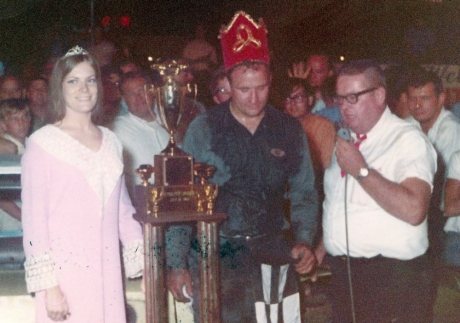
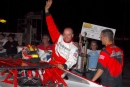
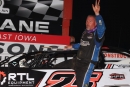
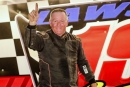
Ed Howe in victory lane at Tri-County Speedway. (Bob Markos)
Dirt tracks in the 1960s were far from things of beauty. More often than not, they were regarded as unsophisticated, downright shoddy mudholes. Promoters looked to furnish a racing surface for competitors and collect the night’s receipts, disregarding creature comforts for ticket-paying patrons. | Slideshow
Fans trudged through slop, sat in broken-down rickety stands, were served concessions out of old wooden shacks and visited washrooms resembling nothing more than rusted out pigsties.
It wasn't a pretty picture. That is, not until Bill Redwine came along.
A real estate mogul from the Cincinnati suburb of Reading, Redwine grew a hankering for Late Model racing, purchased a race car and dove into the sport headfirst. But it didn’t take him long to realize this was an expensive hobby with modest payoffs, suspect track safety and dilapidated facilities.
Redwine decided to raise the bar and build his own racetrack. Not just another hole in the ground, but something to be proud of: a million dollar Taj Mahal for dirt racing.
When rumors spread of Redwine’s plan, some folks thought it was just mere gibberish. Others thought he was off his rocker. Who in their right mind would spend that kind of cabbage on a local dirt track? Yet the Ohio real estate man was determined to alter the sport’s image in a major way.
Naysayers began to change their tune when Redwine and a group of investors met, plans were drawn up and a building permit was obtained. Farm lots on the north side of town in West Chester Township were selected and construction began in November 1967.
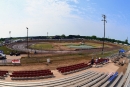
Redwine became a man on a mission. By March 1968, a concrete retaining wall, concessions, grandstands and a two-story press box were virtually completed. All sat atop as fine a half-mile banked, red clay dirt oval as could be laid out. By spring the dream became reality and the ultra-modern half-mile Tri-County Speedway was born.
Upon completion it was billed the World’s Smallest Superspeedway, and many considered it the finest local race facility in the nation.
Tri-County opened in April and the track’s debut brought nothing but rave reviews from all in attendance.
Not only was it a home away from home for its clientele, but also on-track activities were electrifying. An astounding array of talent met there Saturday nights to entertain Redwine’s paying customers. Three- and four-wide racing by the likes of future Hall of Famers Floyd Gilbert, Chuck McWilliams, Larry Moore, Gene Petro, Pat Patrick, Ralph Latham, Vern Lefevers, Billy Teegarden, Bruce Gould and others was a weekly ritual.
Spectators showed up in droves to witness these greats, most in the highest quality equipment. It was big-time racing at an economical price.
The 1968 season ended in a rousing success with the Kentucky hotshoe McWilliams nailing down eighteen victories and the Late Model season title. As a promoter, Redwine tantalized his patrons with a variety of prime-time entertainment. Aside from his extremely competitive Late Model class, open supermodifieds and USAC stockers along with the group’s sprint cars and midgets made appearances at the popular oval.
For his second season, Redwine looked to add a little extra jam on the bread and put together something extremely special. He had visions of hosting a huge Late Model show, something that would knock everyone's socks off and grab the attention of the motorsports world so he could show off his magnificent speed palace and its high level of competition.
In June, a crowd-pleasing 100-lap Ohio State Dirt Track Championship was presented, with, once again, Dodge pilot McWilliams ruling the roost, collecting a hefty $3,400 in purse and lap money from a total purse of more than $9,000. That was regarded as no small potatoes back in the day.
Yet the creative Redwine, the track’s president and general manager, had an even bigger scheme.
Soon, flyers began to circulate for the inaugural United States Half-Mile Dirt Track Championship to be run at Tri-County with eye-catching purse of more than $15,000. The single-night extravaganza would send its victor home with a whopping $3,500 along with lap and bonus monies. It would be the first event of its kind, pitting the best of the traveling circuit boys against the top dogs of the local tracks. The announcement had racers and fans abuzz.
So the last weekend in July, Redwine had his showplace spit-shined and ready to rip for his coveted masterpiece. The history-making showdown drew like a magnet, attracting the best dirt throwers from across Middle America with interlopers from as far away as Tulsa, Okla., and Phoenix, Ariz. Redwine boasted proudly of his talented local contingent, so much so that he offered an extra $500 bounty on top of the winnings for any outsider who could keep his regulars out of victory lane.
The July 26, 1969, tuneup for the big one was contested and ARCA and national standout Ramo Stott of Keokuk, Iowa, gave everyone a chastising, defeating a polished mix of track regulars and outsiders in the 25-lap main event with driver searching for the right stuff for July 27’s weekend finale on Sunday evening. Stott, who had been on a tear in 1969, marked himself as a heavy favorite for the big shindig in his Hemi-powered Plymouth Roadrunner, a combination that would set a national record of 57 main event checkereds on both dirt and asphalt surfaces by season’s end.
For Sunday’s finale, more than 60 of America’s finest dirt racers towed through the gates with top USAC and ARCA new car runners along with the best independent dirt stars from nine states pitside and ready to percolate.
Following qualifications, Redwine may have had second thoughts on his offered bonus as an invasion of Michigan short trackers crashed the party by nailing down six of the top 12 starting spots, including three out of the top four. Marv Parenteau of St. Clair Shores, Mich., a regular at his home state Mount Clemens Raceway, led the determined Michiganders by posting quick time at 21.55 seconds while manning famed Detroit-area car owner Stan Yee’s Chevelle. Other Wolverines qualified and ready to do battle included former Mount Clemens champ Ray Nece, the previous season’s Hillbilly Hundred winner in West Virginia; Hartford Speedway points leader Dick Dunshee; Bay City-area standout Jimmy Roberts in the Eddy Brothers Auto Parts Chevelle; along with skilled pavement extraordinaires Bob Senneker and Ed Howe.
Senneker, who two nights earlier grabbed a home-state victory in a 100-lap MARC Times Invitational at Berlin Raceway, was an occasional dirt participant. Howe wasn’t. It was a race surface the Beaverton, Mich., speedster, known as the Green Hornet, was none too fond of.
“I just really didn’t care for dirt,” said the eight-year racing veteran from the Great Lakes State. “I had kinda gotten away from it for a couple of years and we were racing at Auburn the Thursday before and Jim Roberts was telling us about the big invitational down here and that we should go. Well I said, ‘I don’t know, that’s a long way and I haven’t run dirt in a helluva long time,’ but he talked me into coming down.”
Others who made the cut were Tri-County points leader Chuck McWilliams in the Skilcraft 69 Dodge Charger; previous Brownstown (Ind.) Speedway champ Gene Petro in Frank Ruth's Chevelle; Bob Wearing, who had been on his usual tear of dirt tracks in Western Pennsylvania; the “Hoosier Honker” Larry Moore of Greens Fork, Ind., having a great campaign in Darrell Woodbury’s Chevrolet; Bruce Gould, piloting Porter Lanigan’s potent Hemi-powered Plymouth; and 1969 Tri-County Rookie of the Year Joey Stricker of Batavia, Ohio, behind the wheel of a Jack Bowsher-built Ford Torino.
Sunday’s program kicked off with a barnburner of a four-lap dash, which saw Senneker and Howe bring the crowd to its feet by coming across the line side by side in a photo finish.
Qualifying heats were nailed down by Stott, who had lost an engine in warmups but took over the controls of Jim Cook’s famous “Flying Zero” Plymouth; local runner Gene Cleveland in his Chevelle; Zanesville, Ohio banstormer Dorus Wisecarver; and perennial Columbus (Ohio) Speedway kingpin Don Gregory. A stout McWilliams powered home ahead of the 12 quickest qualifiers in the fast heat to set the stage for the much anticipated 100-lap finale.
Before a healthy 7,200 spectators, the green flag unfurled on the star-studded 25-car field under threatening skies and warm, humid temps.
With the top 12 starters inverted, Stricker got the jump on polesitting Michigander Jim Roberts. Little Joe showed some steam by stretching his lead to several lengths as Bruce Gould and Larry Moore edged by Roberts to take up the chase. By the 14th lap, the 10th-starting Howe was moving his green 1966 Chevelle forward in a hurry, threatening the top five. One circuit later the former Auburn and Dixie Speedways champ dropped to the bottom groove and sneaked by Roberts and Senneker to grab fourth. Howe continued his charge to the front, overtaking Moore and Gould by the 27th lap and beginning his pursuit of Stricker, who had built nearly a quarter-lap advantage. The Green Hornet was flat flying, quickly reeling in the leader by using the low line and maneuvered under Stricker’s Ford on lap 36 to take command.
By lap 57, with Howe stretching out his lead, a red flag was displayed for a multicar pileup involving Marv Parenteau, Gene Cleveland and the second-running Stricker.
“During the red flag I actually didn’t know I was leading,” Howe said. “I was racing against all strange guys out there and was passing cars but I had no idea where I was at. So I just came around and parked on the frontstretch waiting for them to put me somewhere and I’ll be darn they put me in front.”
With Stricker forced to retire, Moore inherited second and got side-by-side with the frontrunning Howe. But Howe got the better bite and resisted what would turn out to be his last serious challenge.
The Michigan barnstormer showed immense power with his big home-built 427 and was in a race of his own, pulling away to a half-track advantage at the checkers.
Howe’s spectacular performance in the lucrative century grind overshadowed a frantic run behind him for the runner-up spot as Moore, Gould and Don Gregory battled lap after lap. At the line, Moore held off Gregory, the 1967 Hillbilly Hundred winner, and Gould to take home the $750 bridesmaid money. Parenteau, who was forced to start on the tail following the red flag, rallied to finish fifth while mudmasters Wisecarver, Wearing, Cleveland, Petro and Gilbert rounded out the top 10.
While accepting accolades for his monumental triumph, which included, a check for an unheard of $5,000 (including bonus and lap money), a 6-foot trophy and a crown signifying King of Dirt, the 30-year old machinist and part-time racer continued to insist on his dissatisfaction of competing on clay surfaces.
“I still don’t like dirt,” Howe claimed before a surprised audience during his postrace interview.
The runner-up Moore, who had been on the mend in recent weeks after burning his foot in the cockpit during competition, congratulated the man who beat him on his weekly home stomping grounds.
“Where in the hell did you come from?” Moore asked. “I have never seen a car run so quick or a driver run so smooth. It has been a pleasure to run second to such a combination.”
Howe’s winning formula that night for defeating the nation’s best dirt trackers in a primarily asphalt race machine had many pitside, including the experts, perplexed.
“Everyone had on those great big 15-inch Firestone tires,” Howe said, “and following our heat we weren’t being very competitive and thought we really had no chance of winning. So I had a set of Dunlop Rain Tires that I had bought, which were actually farm implement-stamped reject tires, and we put them on instead of wearing out a good set of tires. We also bolted a floor jack with a big ol' log chain wrapped around it to the frame in the trunk for better handling. We were desperately trying different things and all of a sudden everything came to life, it certainly paid off.”
The historically significant payday on a dirt track in southern Ohio in 1969 has to be noted as pure magic, for just one night earlier in Nashville, Tenn., the legendary Richard Petty was awarded $3,000 for leading 398 of 400 laps in a NASCAR Grand National event.
“For us that was really a big deal at the time,” remembered Howe, later a Michigan Motorsports and National Dirt Late Model Hall of Famer. “For me the only thing that compared to that was winning at Heidelberg.”
The legendary Wolverine racer and car builder won Pennsylvania's Heidelberg National Open 250 in 1971 and '73, the only two-time winner of the most celebrated asphalt short track event of its kind during that period in Middle America.
Redwine's U.S. Half-Mile Dirt Championship is remembered for setting the tone for the later World 100s of promoter Earl Baltes at Eldora Speedway in Rossburg, Ohio. And the most prestigious independent dirt stock car race in America was also remembered because of the irony that the first coronated King of Dirt didn’t really care for the stuff!