

DirtonDirt exclusive
Fast cars, white shoes and the Tupelo Flash
By Kyle McFadden
DirtonDirt staff reporter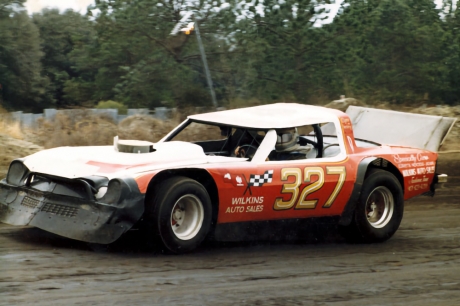
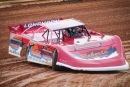
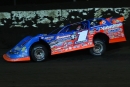
Don Hester's No. 327 race car. (Lee Gammell photo)
A dominance and resourcefulness like few others. An unmistakable flamboyance. A goodwill perhaps most enduring of all. Even the way he drove — by only using his right foot to brake and throttle — made him as unique as they come.
Don Hester left a legacy in just about every sense, especially among those who knew — and raced against — the Tupelo Flash across northeast Mississippi and beyond. | DirtWire
The 2009 National Dirt Late Model Hall of Fame inductee died Sunday at a Tupelo, Miss., nursing home after battling pneumonia that developed into sepsis. He was 84.
His on-track accomplishments alone place him among the sport’s all-time greats, whether that’s nationally, regionally or locally: nearly 600 victories from 1963-85, a 51-win season in ’79, the inaugural Southern All Star Dirt Racing Series championship in ’83 over Gene Chupp and Red Farmer, and two Georgia-Florida Speedweeks victories at Volusia County Speedway in Barberville, Fla.
But beyond the glittering accomplishments that reflected his fiery competitiveness, it was Hester’s charisma, outsized personality and benevolence — even toward his fiercest rivals, like 1984 Southern All Star champ Jerry Inmon, who befriended Hester along the way — that live longest among those who knew him.
“He was one of the best friends I ever had,” said Inmon, of Bruce, Miss., who called Hester “like the A.J. Foyt” of northeast Mississippi’s racing scene. “He was a good man. He truly was. … He was a rival (at first). Don, of course he raced everybody hard. He raced to win, that’s what he does. Most everybody races to win, but he was just a little bit more bullheaded about that. He wanted to win that race. … He was just a good race car driver.”
The nickname that followed Hester fit that reputation, as his “Tupelo Flash” nickname arrived around the same time Jerry Reed popularized “The Tupelo Mississippi Flash” in reference to Elvis Presley — only Hester made the moniker his own on dirt tracks across Mississippi, Alabama, Tennessee and Florida.
So, just how good was Hester?
Johnny Stokes, the 72-year-old who’s one of three Mississippians in the National Dirt Late Model Hall of Fame alongside Hester and Inmon, feared Hester — at the height of his career in the 1970s and early ’80s — more than Scott Bloomquist or Billy Moyer during their primes in the ’90s and early 2000s.
“When I was young and starting out, yes — yes,” Stokes said when asked if Hester was the most-feared driver he ever competed against. “Now (Jeff) Purvis, Bloomquist, Moyer, they were the kings to me in the ’90s and late ’80s … 2000s. But back in the ’70s, or the ’80s, Don Hester was as good as it was — to me. … He was the man in the day.”
Stokes began racing at 15 in the summer of 1970, and while it took a few years for Hester to get to know him, Stokes had long been aware of Hester’s towering stature. Their connection began fittingly, like the start of a timeless story, in the summer of 1974.
Hester had relinquished his ride with Maron Fairchild of Fairchild Racing Equipment a few weeks earlier, claiming he couldn’t get comfortable with a Holman-Moody Ford engine. Though Holman-Moody ranked among racing’s premier Ford builders in the 1960s — its cars famously carried Mario Andretti to victory in the 1967 Daytona 500 — Hester wanted no part of it, saying the engine “turned backwards” compared to a conventional powerplant.
“He called (the motor) a flathead. The torque on the car went to the right-rear instead of the left-rear,” Stokes said. “Well, it was a problem, because the car wanted to spin out all the time.”
Hester was apparently a diehard Chevrolet man — his tolerance for Fords, like the one Fairchild owned, ran short — so much so that the famous No. 327 he carried for much of his career was inspired by the Chevy 327, General Motors legendary small-block V-8 produced from 1962-69.
Stokes recalls Hester eventually purchasing a 1966 Chevrolet Nova with a 454-cubic-inch big-block V-8 engine from Missouri’s Larry Phillips in ’74, a transaction he remembers because “he came back and kicked butt.” But it became even more memorable when Stokes replaced Hester in the Fairchild-owned ride, which “was basically a ’55 Ford frame.”
In his second weekend in the car, Stokes beat Hester head-to-head, passing him in the final laps of a feature at Columbus Speedway for his first career Dirt Late Model victory.
“These folks talked Fairchild into letting me try that Ford,” Stokes said. “The second week I drove it, I passed Don at Columbus (Miss.) Speedway on lap 17 (of 20) and won the race. It was kind of funny.”
That moment kindled Stokes’s relationship with Hester, one that remained intact until Hester’s death.
“He came over there (in victory lane) and shook my hand, and I remember what he told Fairchild,” Stokes said. “He said: ‘Fairchild, you got you a good one now.’ I remember him telling him that.”
From then on, Stokes shared countless experiences with Hester, who often lended an extra hand around the shop, even helping assemble race cars when the two competing chassis in the 1980s: Stokes in a Bullitt and Hester in a Jig-A-Lo.
Hester also helped Stokes dial in the weight of his race cars on a feed scale, the old-school platform scale at a local feed mill that racers used before digital pad scales became commonplace.
“I got to outrun him that week because he helped me so much,” Stokes said. “He would help anybody that asked him.”
Some of Hester’s best stories are those that capture his charisma.
“Don was kind of flashy,” Stokes said. “He’d wear a diamond ring, and back before blue jeans had little designs on the rear pockets — nobody had done that — but Don, that’s what he was.”
Even all these years later, the 84-year-old Inmon vividly recalls how Hester styled himself.
“When he was growing up, when we first started racing, he’d race you with these white loafers on and split blue jeans up the side,” Inmon said. “Don, he was a neat dresser.”
Hester’s polished appearance fit his life away from the racetrack, too. He co-owned Little Kar City with his brother Dan, helping make it the first Toyota franchise dealership in the Tupelo area, and that car-dealer persona often followed him to the races.
“They always stayed kind of cleaned up,” said Scott Flurry, who crewed for Hester from 1978-86, from the time he was 12 until he was 19. “It was funny. He’d come to the races in these white, slick leather shoes, and his jeans had the press seam down the front. He’d have his button-up shirt on, and that gold cigarette lighter in his pocket.”
The white racing shoes, specifically, were his trademark accessory.
“He was known for those white shoes,” Stokes said. “They were like old slippers.”
Fairchild, Stokes’s car owner at the time, had bought Hester’s black Chevrolet ramp truck — the same truck Hester used to haul his race car. One night in Louisville, Miss., Stokes looked over and saw Hester rummaging through it, tearing out boxes and whatever else was inside.
Stokes scuttled over, wondering why Hester had intruded into their space.
“What the hell are you doing, Don?” he asked.
“I ain’t won a race since I got rid of this truck,” Hester told him. “I lost my white shoes and I think I left ’em in here somewhere.”
Stokes knew Hester had found them, too, because Hester returned to victory lane that night.
“And he started winning again,” Stokes said.
Another hallmark Hester moment often came before the green flag ever flew. Back then, drivers wore open-faced helmets with goggles, and Hester was notorious for smoking a cigarette until the last instant. If a driver lined up beside him on the front row, Stokes said, there was one striking routine.
“Back then, you went green going into turn three,” Stokes said. “Don would be smoking a cigarette going down the back straightaway. And when he flipped that cigarette, he was wide-open.”
To Stokes, once Hester flipped the cigarette, it was go time.
“He was going to get that jump,” Stokes said.
Flurry could only shake his head, both metaphorically and literally, whenever Hester lit a cigarette in the race car.
“He’d have his helmet kicked back on his head … and under caution, he’d have a damn cigarette lit,” Flurry said. “He’d be coming down the back straightaway, and they’d turn the yellow light on, and I’m like, ‘Dear God, put your helmet on!’ You’d see him flick that cigarette, pull his helmet down, and the race was on.
“People used to get so tickled about that. He just had his own unique style about a lot of things.”
The maverick nature extended to the way Hester physically drove the car, too.
“Believe it or not … he drove with one foot,” Flurry said, explaining that Hester used only his right foot for both the brake and throttle. “Nowadays, you finesse a car, you ride the brakes, you’re easy on the gas. But back then, he would have us put a little toeplate on the left side so he could take his leg and push himself back in the seat. … I mean, that would hardly work these days. Even back then, it was entirely different.”
And if Hester’s driving style was unconventional, his problem-solving was right up there with it.
Hester had bent an axle tube on his car in a previous race, but didn’t realize the issue until one Sunday evening at North Alabama Speedway. After fixing it, he returned to the track, but vented to Stokes that “he still wasn’t no better.”
That’s when Stokes noticed Hester doing something unusual near a light pole.
“After the heat race, I seen Don over there, he had a chain tied to a light pole in the infield,” Stokes said. “He tied it around that axle on that car. He’d get in that car and take off.”
Stokes walked over the check on him.
“I went up there and said, ‘Don! What are you doing?’ ” Stokes said. “He said, ‘This thing ain’t been worth a crap since I fixed that axle tube! I should’ve bent it back.’ ”
So Hester did exactly that. Then he won.
“He was ahead of his time,” Stokes said. “He was kind of like Kyle Busch. He was just raw talent. He just outdrove you. It didn’t matter what it was, he just wanted to outdrive you. He wanted to win so bad.”
If Stokes had to compare Hester to a modern-day driver, he’d point to Tyler Erb or Bobby Pierce, drivers known for getting everything they can out of a race car while ruffling some feathers along the way.
“Whatever it took, he was going for it,” Stokes said. “That’s a fact — every lap.”
That all-out approach took root well before Hester became one of Mississippi's most feared Dirt Late Model competitors.
As Leesha Faulkner, a contributing columnist for the Daily Journal of Tupelo, Miss., wrote in a 2022 column, Hester’s brother, Dan, helped obtain the land for Tupelo Sports Arena, a dirt track built in 1949 just south of the railroad tracks on Old U.S. 78. Dan and nine other racing enthusiasts each put up about $1,500 to build the track, which operated until 1953.
Even after the track closed, Don Hester kept forging his own racing path. His nephew, Mike Hester, told Faulkner that once Don committed to something, he went “full blast,” a determination reflected in the family story of Hester turning Dan’s prized 1957 Chevy from the dealership lot into a roll-caged stock car while Dan was away on vacation.
“Don is the kind of person if he committed, he was going to go full blast,” Mike Hester said. “He loved to win.”
According to a May 2001 Dirt Late Model Magazine article by Tim Henry, Hester was one of only three Late Model drivers — dirt or pavement — credited with winning 50-plus features in a single season, joining Jerry Inmon and pavement short-track legend Dick Trickle.
Among Hester’s noteworthy career Dirt Late Model victories were the 1977-78 Southeastern Winternationals at Volusia County Speedway in Barberville, Fla.; the 1980 Boss 100 at Rome (Ga.) Speedway; and the 1982 Tri-State Championship at Whynot Speedway near Meridian, Miss. He also captured 1979’s lucrative National 100 at East Alabama Motor Speedway in Phenix City, Ala.
That body of work, according to Henry — a racing historian of sorts in northeast Mississippi — solidifies Hester as one of the sport’s greatest.
“To me, if you’re in the Hall of Fame right now, you’re at least in the top 50,” Henry said. “That’s just my opinion. Everyone’s got one. … He was my childhood hero. He’d go out of his way to help drivers. He would race ‘em hard, but he’d help ‘em anyway he could.”
When Hester entered a Tupelo nursing home two years ago, he became harder to visit for close friends like Inmon. For years, the two had lived about 45 minutes apart and often visited each other’s homes. Even after Hester’s move, Inmon still made it a point to see him when he could.
His most recent visit came about a month before Hester’s death. Inmon didn’t know then it would be the last time he’d see his longtime friend.
But part of that final conversation now feels fitting. Hester, Inmon said, always seemed to know where he was going, especially on the racetrack, where “he wanted to be up front, and he could just about get there every time.”
Near the end, Hester had the same sense of direction.
“He told me, the last time I talked to him, that this is my last home,” Inmon said. “When I leave this place, I’m going to heaven.”